abc

Category: College Counseling

  • Alternate US Colleges and Why You Should Consider Them

    Alternate US Colleges and Why You Should Consider Them

    Best Alternative Colleges in the US & Why Should Consider Them?


    Alternative US Colleges to Consider in your Search

    Ever thought of attending a university where you don’t receive letter grades, but instead narrative evaluations from your professors, or one where you get to voice your opinion without thinking twice?

    Introducing ‘Alternative Colleges’. Unknown to most international students, the student body from these colleges welcome students from all ethnicities, races, gender, sexuality with open arms. These colleges are non-conforming and follow uniquely designed curriculums, that can only be termed ‘liberal’ and ‘liberating’.

    Here’s a list of colleges you could consider:

    1) Pitzer College, California

    Part of the Claremont Consortium, Pitzer is one of the most reputed alternative colleges. A small liberal arts college with just over 1,000 undergraduate students, it is known for its “progressive thought, social responsibility, environmental sustainability, and open social attitude.”

    Pitzer is the first in the country to offer a Secular Studies major, which includes courses on God, Darwin, and Design. The community government makes decisions on faculty promotion and curriculum. Individualism is treasured here, sometimes fiercely. In the 1970s, Pitzer students saved a California craftsman-style house from a wrecking ball and moved its pieces to campus. It now serves as a study space and restaurant for students.

    2) Oberlin, Ohio

    Named as the college that invented non-conformity, you’ll find the annual Drag Ball an experience. It is the first college to accept women and minorities. Oberlin Conservatory of Music is one of the best performance schools. EXCO, the Experimental College offers townspeople and students the chance to learn together. You will find students talking about anything ranging from Japanese woodblock prints to Russian cinema. Social activism is huge. Oberlin College and Conservatory

    3) Hampshire College, New York

    Students design their own interdisciplinary concentrations and projects. Part of the five-college consortium with Amherst College, UMass Amherst, Smith College, and Mount Holyoke. The Kern Center looks into building environmental sustainability, making the campus 100% solar-run. The best part is that you don’t get graded on your exams, instead, your professors provide you with ‘narrative evaluations’ (written evaluations and critiques). Along similar lines, students don’t give tests but are expected to submit portfolios, evaluations, and self-reflections on academic development. No wonder they refuse to accept SAT/ACT scores.

    The most unique feature of this college is the ‘Division System’ which ensures that there are as many curricula as students, on campus, each one curating their own with the help of faculty advising. Hampshire College | Hampshire College

    4) Sarah Lawrence, New York

    For those who love writing, Sarah Lawrence is the place to be. You’ll get a ‘don’, a professor specifically assigned to mentor you through your college years. Academics are mostly independently procured, so you’ll need to be self-driven and independent. Writing, Literature, Visual Arts, Filmmaking, and Psychology are popular majors. They have a great premed program along with strengths in the CS department. Professors meet their designated students weekly or biweekly following Oxford University’s tutorial system, ensuring students don’t fall behind. ‘Conference Work’, or research is nearly done by all students under the supervision of their ‘don’. SL is high on student activism and you’d rarely ever meet a conservative on campus. Welcome to Sarah Lawrence College

    5) Reed College, Oregon

    Quirky intellectualism – two words that describe Reed students. Steve Jobs attended a semester here before dropping out and going ahead to found Apple.

    It follows the Honors Principle, similar to Quaker colleges. Students receive lengthy commentaries in the form of evaluations. Has the highest percentage of grads from a liberal arts college opting for PhDs in the future.

    ‘The Multicultural Resource Center’ celebrates student and teacher diversity through events, lectures, etc. There are six ‘language houses’ and each gets a native speaker. ‘Paideia’ is a weeklong program of non-credit, alternative classes such as how to speak with a French accent to the history of Batman. Tons of students participate in SEEDS (Students for Education, Empowerment, and Direct Service). Reed College

    6) Bard College, New York

    Known for its non-conformism, freshmen arrive three weeks before classes start for a ‘Workshop in Language and Thinking’. ‘Citizen Science’ is a unique 3-week workshop where students learn about topics like infectious diseases and teach these to the students in local schools. Bard conducts ‘Moderation’, a performance review in the middle of the year, where a panel of professors assesses and provides feedback. Photography is the toughest major to get into but is also known for programs like Languages and Literature, Visual and Performing Arts, Human Rights, CS, Biology (similar to Sarah Lawrence).

    Students can also devise their syllabus from their tutorial and find a professor to sponsor it. Also, Bard allows you to take an Entrance Examination where students demonstrate their academic ability by submitting four 2500-word essays that get graded by profs.

    Apart from these, other alternative colleges are Hamilton College, Occidental College, and Prescott College.

    If you’d like to design your path, need extensive teacher support, love student activism, are non-conforming, or have unique interests, do consider these amazing alternative colleges where you’re driven to make a change!


    All You Need to Know About Bethany College

  • Test Optional and Test Blind for Admission Cycles

    Test Optional and Test Blind for Admission Cycles

    Understanding Test Optional and Test Blind for Admission Cycles


    To Test or Not to Test in 2023-24?

    What Does it Mean to be Test-Optional (2023-24)?

    Many Universities in the US are remaining Test-Optional for the upcoming application season (2023-24). Recently, Columbia University was the first Ivy League to no longer require SAT/ACT testing as of 2023-24 and will be test-optional permanently. Many Universities & Colleges across the US are continuing with their test-optional policy in 2023-24, with only a handful confirming that they will resume testing policies for 2023-24.

    Would you benefit from submitting a score to a test-optional university?

    It depends; you should submit your score if it falls in the top 25th percentile of admitted students to that college in the previous year. On the other hand, if you have a lower score you should work hard to enhance your profile with good quality extra-curricular activities, recommendation letters, college application essays, and your school GPA. The universities focus on a holistic review while selecting a diverse group of an incoming undergraduate class. The students will not be disadvantaged if they do not submit their test scores(yippee).

    Prioritize Academic Fit When Choosing a College or University

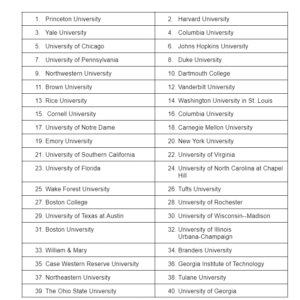
    Here is a list of some Top research universities that are test optional for the 2023-2024 admissions cycle:

    Understanding Test Optional and Test Blind for Admission Cycles

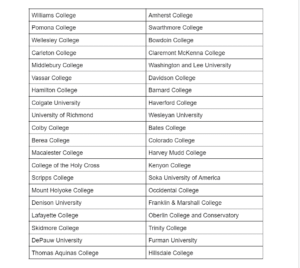
    Here is a list of some Top Liberal Arts Colleges that are test-optional for the 2023-2024 admissions cycle:

    Some Liberal Arts Colleges and Universities Mandate SAT/ACT Testing

    There are some top universities and liberal arts colleges that require you to submit your SAT/ACT scores. Some of the schools that still require testing include Massachusetts Institute of Technology, Georgetown University (DC),  Georgia Institute of Technology, University of Florida, University of Tennessee, Knoxville, New College of Florida, Fisk University (TN), and New College of Florida.

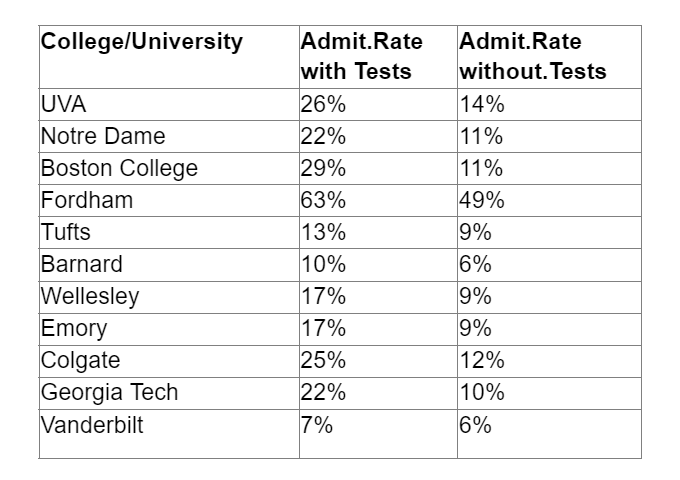
    With insights provided by education writer Jeff Selingo and information from various colleges and universities, we have created the following table to give you an overview about submitting test scores.

    On the face of the above information, it would appear that including a test score greatly increases your chances of acceptance. However, Common App data reported a 20% surge in applications which suggests that they are receiving applications from students that might have been put off applying when a test score was a requirement.
    Read More: Public versus Private Universities

    Were you aware that some universities have adopted a “test-blind” approach?

    Test-blind means that a college or university will not consider your SAT/ACT score as part of their evaluation process, even if you submit it. The University of California, for example, would only use your scores for course placements after you enroll.

    Here is a list from FairTest of some universities and colleges that are test-blind:

    • California Institute of Technology

    • California State University system (permanently at all 23 campuses)

    • Cornell University (through fall 2024 at the schools of Agriculture, Architecture, and Business)

    • City University of New York system (11 campuses, extended through Spring 2023 admissions)

    • University of California system (9 campuses)

    • Washington State University (4 campuses)

    • University of San Diego

    Is your high school profile competent enough or do you need to submit your score to the test-optional universities? If you need further guidance contact the Ivy Central team.

  • Public Vs Private

    Public Vs Private

    What Is the Difference Between Public and Private Universities?

    Differences

    The simple difference between Public and Private Universities is that Public universities are paid for by the state’s taxpayers and private universities run on endowments from alumni etc. This changes the way resources are allocated, and mainly the way students get admitted. For all public universities, the Common Data Set would say that the criteria for admission for state residency are “very important”. The simple logic to this is that public or state universities, given that they are funded through resident taxes, prioritize local or domestic students over out-staters or international applicants. Therefore, most public universities will have about 2%(such as at U.Maryland) to 8% International students.

    For the purpose of this blog, let’s consider differences under these sub-headings – financial, academic, and social.

    Financial Differences: Cost of Attendance

    Attending a public university can be really affordable if you qualify as an in-state student. Even international students do not need to spend exorbitant amounts of money as opposed to what they would at a Private University. The reason again being that private unis run on student tuition and heavy endowments.

    Academic Differences: Size, Support, and Facilities

    Your academic performance at a university can be influenced by its size, the support you receive from faculty and peers, as well as the facilities the university provides. Let’s take a closer look at each of these.

    Read More: US Curriculum Requirements

    1. Size

    Most public universities are large, having students from 20,000 and above. Some of them such as the University of Illinois at Urbana Champaign have over 30,000 students. One of the main reasons for this largeness is that they need to accommodate more instate students as these unis are government funded and the obvious objective is that more students opt to pursue further education post high school. Statistics show that only 37.5% of the US population aged 25 and above had graduated from college or any higher education institution in 2020 as opposed to 7.7% in 1960. To continue this upward trend in creating an educated populace, most public universities have a massive graduate population as well. Naturally, these campuses are huge and spread out to accommodate thousands of students and the facilities they need.

    Private universities on the other hand may be very small such as the liberal arts colleges and unis or could be mid sized universities such as Northwestern University with approximately 8,000 to 9,000 students.

    2. Support

    Public Universities, given the large number of students, often ask post doctoral or graduate students to assist and advise undergraduate students. Sometimes they also take over introductory classes and this may actually work out really well for some students and in certain cases. Although if you would rather prefer having a professor teach you all the courses you’re taking, then public unis may not be ideal for you. Here’s where private universities step up their game. Professors at private unis often have an open door policy and oftentimes also invite students for cookies and tea at their own homes, as they tend to live on the campus or nearby. This accessibility can prove to be really beneficial if you need more academic support.

    The other aspect to consider is career advising. If you’re someone who needs extra support to chart your academic path, then private unis could provide that to you through its career advising services. Given the limited number of students, every advisor has more time available for each of their students.

    3. Facilities

    Given state funding, public universities are known to update their research and lab facilities with the latest equipment and technology. Private Universities are able to do the same through endowments. However, not all private institutions get enough endowments to constantly upgrade their facilities – especially the smaller ones. This could be a challenge for students keen on pursuing top-notch research or hands-on lab experiences at small women colleges.

    Social Differences: Diversity, Social Scene, Housing

    1. Diversity

    Public Universities, while large, reserve their seats for in-staters. This could bring in a uni-dimensional mindset to that university, simply because most of the student community is coming from that state. The UCs increased seats for Californians recently, so it could be assumed that a Californian mindset would govern these campuses. But, who’s complaining?!

    Private Universities attract a multi-cultural population also because the opportunities and the environment to engage with students from across the globe is more accessible, especially if you qualify as an introvert.

    2. Social Scene

    The social scene at public universities is typically governed by athletics. You may just become best friends with your neighbor at a soccer game.

    Both public and private universities offer a Greek life, though not all of them of course. This means pledging allegiance to a sorority or a fraternity club for the time you’re at the university and beyond. They may provide an excellent way to network, and find a support system away from home. However, few Greek clubs have been controversial for issues regarding alcohol abuse, sexism, racism, and elitism. Therefore, it is important that you talk to peers about the club you are keen on joining.

    3. Housing

    Public Universities are often called commuter schools, as a majority of their students live off-campus and commute to college every day. This can make a boarder feel lonely during weekends if they haven’t formed their own circle of friends who live on campus. Most private universities offer a four-year housing plan, and a lot of them make it compulsory for freshmen to live on campus. This helps you bond with nearly everyone and expand your social circle.

    Public or Private: Is there a better fit for you?

    Well, it depends, doesn’t it?

    Typically speaking if you are someone who enjoys interaction, likes to really know the people around you, needs a smaller environment to learn and grow, a private university could be a better fit.

    If you like a larger-than-life social scene, enjoy the rah rah of school spirit, and you would happily take control of your learning, then you would enjoy being at a public university.

    Working with study abroad consultants, overseas education consultants, or, as more commonly known, college counselors, can help you plan ahead and make those high school years count. Ivy Central offers exceptional focus to help you prepare for college admissions throughout the high-schooling years. Start today!

  • What are AP Tests and should I take them?

    What are AP Tests and should I take them?

    What are AP Tests and Why Should I Take AP Exams? Ivy Central


    Should I take AP Tests

    At Ivy Central, students often ask us: Are AP Tests necessary? How many should I take? Do colleges care which ones I choose? This blog addresses those questions and helps you decide whether Advanced Placement (AP) exams should be part of your college application strategy.

    What Are AP Tests?

    Advanced Placement (AP) Tests are standardized exams offered by the College Board, typically taken in May at the end of a year-long AP course. (The exams happen once a year in May.) These courses are designed to mirror introductory college-level classes and are available in many U.S. high schools and international schools. Students can also opt to self-study or take online AP courses through platforms like Pearson or Johns Hopkins CTY.

    Exam Format:

    • Most AP tests include multiple-choice and free-response sections.

    • Language exams include a speaking component.

    • Music Theory includes sight-singing.

    • Studio Art involves portfolio submissions.

    • Exams are scored from 1 to 5, with:

      • 5 = Extremely well qualified

      • 4 = Very well qualified

      • 3 = Qualified

      • 2 = Possibly qualified

      • 1 = No recommendation

    As of recent updates, the College Board now uses Evidence-Based Standard Setting (EBSS) to determine scoring thresholds, which has led to higher pass rates in some subjects.

    Digital AP Testing: What’s Changing in 2025?

    Starting May 2025, AP exams are moving toward digital testing using the College Board’s Bluebook app.

    • Fully Digital (No Paper Option): Humanities and Computer Science exams, including AP English Language, U.S. History, and Computer Science Principles.

    • Hybrid Format: Math and science exams like AP Biology, Calculus, and Physics will deliver questions digitally, but require hand-written responses for problem-solving sections.

    This shift to digital AP exams aims to enhance the overall testing experience in several key ways. First, it improves exam security by reducing the risk of lost papers and unauthorized access to exam content. Additionally, digital testing simplifies the administrative process for schools and test centers, streamlining setup, distribution, and scoring. Most importantly, it helps reduce opportunities for cheating by incorporating more secure and standardized digital environments, ensuring a fairer testing experience for all students. Score Setting and Scoring – AP Central | College Board

    What Subjects Can I Take?

    The College Board offers over 30 AP subjects across STEM, humanities, social sciences, and the arts. Popular and widely available choices include:

    • Sciences: Biology, Chemistry, Physics 1, 2, and C

    • Math: Calculus AB & BC, Statistics

    • Social Studies: U.S. History, World History, Psychology, Government

    • Languages & Arts: Spanish, French, Music Theory, Studio Art

    Updated Physics Curriculum: For the May 2025 AP exams, the AP Physics curriculum has been updated to align more closely with college-level coursework, emphasizing clearer expectations for essential content and skills. The revisions include:

    • AP Physics 1: A new Fluids unit has been introduced, expanding the course to eight total units.
    • AP Physics 2: The former Waves and Optics unit has been divided into two distinct units: Geometric Optics and Waves, Sound, and Physical Optics.
    • AP Physics C (Mechanics and Electricity & Magnetism): Both courses feature updated structures, with changes to the number and format of multiple-choice and free-response questions, along with a longer exam duration.

    How APs Help Your Application:

    1. Demonstrate Rigor: APs show that you can handle college-level material, especially if your school’s curriculum isn’t the most challenging.

    2. Showcase Academic Interests: Taking APs in subjects not offered at school signals intellectual curiosity and initiative.

    3. Compensate for Discontinued SAT Subject Tests: Since 2021, APs are one of the best ways to demonstrate subject mastery.

     Additional Benefits of Taking AP Exams

    1. Earn College Credit or Skip Intro Courses

    Scoring a 3 or above may allow you to skip general education courses in college, freeing time for advanced classes or electives—and in some cases, enabling early graduation.

    2. Strengthen Merit Scholarship Applications

    Some colleges factor AP performance into merit-based scholarship decisions. Taking APs can make you a more competitive candidate for financial aid.

    When Not to Take APs

    While APs are valuable, they are not for everyone. Consider skipping or delaying APs if:

    • Your school grades are struggling: Focus on improving GPA, which is often more critical.

    • Your extracurriculars are weak: Top colleges look for both academic strength and personal achievements.

    • You are already overwhelmed, and AP prep would compromise balance and well-being.

    Remember: Quality matters more than quantity. One well-prepared AP score is better than several poorly handled ones.

     Should You Take APs?

    Here’s a quick checklist to help you decide:

    • Are you academically strong and looking to challenge yourself?

    •  Do you want to demonstrate subject expertise not reflected in your school curriculum?

    • Are you aiming for top-tier colleges or merit scholarships?

    • Do you have the time to prepare without compromising your GPA or well-being?

    If you answered yes to most of these, AP exams may be a great addition to your college application strategy.

    Final Thoughts

    AP exams can significantly enhance your academic profile when used strategically. But they are just one part of a broader application narrative that includes GPA, extracurriculars, essays, recommendations, and standardized test scores (if required).

    If you’re unsure which APs to take or how they fit into your academic goals, reach out to Ivy Central. We’re here to help you build the right strategy for success.

    Here at Ivy Central, we get lots of questions about AP Tests, whether they are needed or useful in the US college application process, how many you should do, and are some subjects are more valuable than others. This article will help you answer these and other questions about AP Tests.

  • Understanding College Rankings

    Understanding College Rankings

    Expert Guide to Understanding US and UK College RankingsSeptember is college rankings season. Across the world, websites and newspapers publish stories about the rankings of colleges and universities; some focus on specific countries like the US and UK, while others claim to tell you which are the ‘best’ in the world.

    While there are many other factors that students should use when making final admission decisions, college ranking lists are a resource that applicants should use, so in this blog, I’m going to help you understand college rankings.

    What are rankings?

    College rankings have been around for many years. Offering a list of colleges, ordered by numerical scores, they have become an essential part of the annual education cycle, with the US News, Times Higher Education, Forbes, and Shanghai rankings all being published in September each year. On the face of it, the rankings offer an easy way to compare one college against another, but this is different. Each compiler will use vastly different criteria when determining the status of institutions. The more prestigious lists seek to base their results on objective, statistical information, but many lists use more subjective assessments, such as students’ views. To make the most of the information that ranking lists contain is vital to understand what is being measured.

    How college rankings are compiled

    If you look at the three college rankings mentioned above, one thing is very apparent; there is little agreement across the rankings about which is the ’best’ college or university; while both US News has Princeton topping their list of national colleges, Shanghai has Harvard topping while the Times Higher Education ranking names Oxford University as its’ top institution in the world. So how is it that different rankings can come up with different results? Well, it’s all down to what was mentioned earlier, different rankings use different criteria to calculate their lists.

    Let’s compare what US News and Times Higher Education consider when they assess institutions. Both ranking methodologies use quantitative and qualitative data to base their results on, but what they look at is quite different. The top two factors for US News are Graduation and Retention Rates and the subjective assessment by peers and counselors, each of which constitutes 22.5% of the total ranking score. The Times Higher Education methodology is a little more complex; it has three top factors, Teaching, Citations, and Research, each of which counts 30% towards the overall ranking. The teaching element includes a reputation survey to measure the “perceived prestige of institutions in teaching” and the student-teacher ratio at the school. The research consists of a study to judge the “university’s reputation for research excellence among its peers” and a measure of income the school makes related to its research. Finally, the citations element of the methodology seeks to assess the institution’s role in spreading new knowledge by capturing the number of times the universities published research cited by scholars.

    The difference between the two methodologies becomes starker when you look at the other factors being considered. US News includes elements such as student selectivity (12.5%) and alumni giving (5%), which are significant factors for US colleges but have less relevance for other parts of the world where less store is placed on such measures. Using reputational rankings can become a circular discussion: a strong reputation leads to a strong reputation. This benefits well-known universities but fails to reflect the benefits of teaching and learning, research, community engagement, or any other academic activity.

    The Forbes rankings are different again. Unlike the other three, the Forbes rankings only cover universities and colleges in the US. It places the highest weight on alumni salary, with slightly less importance given to debt load, graduation rate, return on investment, and the leadership and entrepreneurial success of graduates. Having the focus on salary debt load and return on investment results in colleges that charge less but achieve good outcomes for students appearing higher up the ranking links. While MIT tops the Forbes list, in third place is the University of California Berkeley, while UCLA and UC San Diego also appear in the top 20. In the US News rankings, Berkeley only makes 20th place.

    Given that each ranking will be looking at different things and placing a different emphasis on them, it is common that they come up with different results, so it is wise to understand which ranking best aligns with individual student priorities.

    Final Thoughts

    College rankings can be a handy tool for students, especially as they begin their explorations of colleges. Alongside the numbered list, they usually have helpful overviews of the different institutions. It can be unhelpful to put too much emphasis on rankings. However, other factors such as size, location, and what the program includes should also be key when deciding which colleges to apply to.

  • And the Graduation Rate is…..

    And the Graduation Rate is…..

    US Colleges & Universities with high Graduation Rates | Ivy Central

    There are many considerations that you should use to decide which college is right for you. Having the right major is one of the most important, as will be the reputation of the college, its size, location, and student body. Another aspect you should look for when researching your college options is the graduation rate; this can tell you a lot about the quality of the education provided by a college.

    Degree courses in the US are based around a four-year program of study, but across all institutions offering degrees, the average time it takes students to graduate is over five years. The reasons for this are numerous. It might be that a student changes their major, or there are personal circumstances that result in them taking time out from their studies, but it might also reflect difficulties in getting a place on popular courses or struggling to pass a graduation requirement.

    Read More: Ivy League Universities

    Graduating in four years means reducing the cost of college; if you take longer, additional tuition, accommodation, and food will need to be paid for. This is where the institution’s graduation rate comes in.

    The graduation rate is expressed as a percentage of those starting at the college as a freshman who go on to graduate from the same institution; they will usually show this as a four and six-year graduation rate. If the institution has a high graduation rate within four years, it suggests that the odds of completing the degree in that time are good.

     It is important to note that the graduation rate is not the same as the retention rate, which shows the percentage of students who return to the same college for their second year.

    According to The Chronicle of Higher Education, the colleges and universities in the United States with the highest six-year graduation rates include:

    ·       Yale University (97.5%)

    ·       Princeton University (97.3%)

    ·       Harvard University (96.4%)

    ·       Dartmouth College (95.9%)

    ·       Harvey Mudd College (95.9%)

    ·       University of Pennsylvania (95.7%)

    ·       Duke University (95.4%)

    ·       Bowdoin College (95.2%)

    ·       University of Notre Dame (95.2%)

    ·       Amherst College (95.2%)

    Out of the public colleges, those with the highest graduation rates are:

    ·      U of Virginia (94.6%)

    ·      College of William and Mary (92.1%)

    ·      U of Michigan at Ann Arbor (91.6%)

    ·      U of California Berkley (91.1%)

    ·      U of North Carolina Chapel Hill (90.9%)

    ·      U of California Los Angeles (90.9%)

    ·      U of Florida (88%)

    ·      U of Wisconsin Madison (87.2%)

    ·      The College of New Jersey (86.6%)

    ·      U of Maryland at College Park (85.4%)

    Other colleges that are popular with our students include:

    ·      Georgia Institute of Technology (85.3%)

    ·      U of Washington Seattle (84.4%)

    ·      U of Texas at Austin (82.7%)

  • Journey to US College-What Students Should Consider

    Journey to US College-What Students Should Consider

    Exploring Journey to US College | Key Considerations for Students


    Journey to a US College-What Students Should Consider

    It can be very easy to be seduced by the idea of going to college, particularly at one of the great colleges and universities worldwide. The good news is that the dream is increasingly becoming a reality for those who aspire to this goal ,but achieving it is not always straightforward and can sometimes come as a shock.

    In this article, I want to help anybody considering applying to a US college, and their families, think about some of the hard questions that will need to be answered on their journey toward college and university.

    Academics

    People have all sorts of motivations for applying to college. It might be the prospect of exploring an area of interest in more detail or the freedom to develop into the adult you want to be. Whatever your motivations, for colleges and universities, it is about you as a student, and while US colleges look at more than just your grades, how you perform at school is an essential element of your application and graduation rate.

    Not all colleges expect the same academic performance; top colleges will expect a higher academic achievement, so you must take a step back and look at how you have performed over the last few years. The good news is that, in most cases, an institution will match your academic performance, but that might be different from the college of your dreams.

    Top colleges, like the Ivy Leagues, will expect you to have averaged A’s across the four years of high school. So, if an Ivy League is your dream, look at the grades you have been getting; if they are not A’s, then ask yourself if you can and are willing to do the work needed to turn them into A’s.

    If you are not that A student, then by all means, still apply, if that is your dream, but also make applications for colleges that better reflect the grades you are achieving. Ivy Central would advise that at least half of your applications should be made to what we call target institutions. These are ones that broadly align with your academic performance. If you don’t get the grades you expect, you should include at least one safety college.

    Another question you should ask yourself is, ‘are the subjects you are good at the subjects that are important for what you want to study or indeed work in?’ Over my career, I have met many young people who have a view about what they want to study that is incompatible with their academic strengths. For example, they might wish to study mechanical engineering at college, but maths is not a strong subject for them, and they dislike physics, both integral subjects for what they want to study. Too often, these people drop out of their studies because they can’t cope with the work or it just does not interest them enough. Fortunately, switching from one major to another in the US is often possible, but a hard, realistic assessment of their strengths can help you avoid that.

    Occasionally students feel pressure from family or friends to aim for a particular study area. It is essential to recognize this pressure and for you, the student, to own the decision about what you do at college. Try to understand the feelings family and friends have about your future, try to help them understand why you believe your choice is right for you and your dreams, and realize your concerns about pursuing the major they would prefer you to follow.

    Asking yourself these questions is not always easy; it can be hard to refocus your dreams if the reality does not fit. However, the ability to reflect on who you are is an important skill to master and will help you to make better decisions throughout your life.

    Read More: Public versus Private Universities

    Family discussions

    While you will be the one attending university, the support and encouragement of your family should be an essential consideration. While you will have your dreams about going to college, your family will likely have dreams for you as well. Hopefully, those dreams will match yours, but that is not always the case. There have been occasions where the parents of students we have worked with have wanted their son or daughter to attend a particular college or sometimes go to a college near family members who can offer support.

    Another important area to have an early conversation with your family about is cost. Irrespective of where you go to college, it is expensive, so talk to your family about what the family can afford. Sometimes we see students who have the potential to be accepted by one of the highly selective private colleges in the United States but are not able to afford the high costs that can be required. In those circumstances, it might be better to focus on slightly less selective colleges that will appreciate what you bring to the college community and provide you with scholarship money to make it more affordable. This can be a particularly beneficial strategy if you intend to go onto one of the professional programs like medicine or law.

    One of the most common areas where we see differences between parents and students is what to study. Some parents will put a value in studying a particular major, typically in the STEM areas, but you, the student, might want to pursue your interest in the arts or humanities. Understanding these tensions can help you when considering your choice of college. For example, you could look at colleges that will provide the opportunity to follow a double major, one with more of a STEM focus and a second in the areas you want to follow.

    Planning

    Another consideration is that you should try to be realistic about the amount of time you have or can put into applying to college.

    Applications to top-tier colleges take time.

    A student at the end of Gr 11 only has six months before the application round ends; during that time, in addition to all of the work you are doing for the application, you will also have to keep on top of your school work and continuing to work on your extracurricular activities. So when you are starting the process of building your application profile is essential. The earlier you start, the better.

    Even if you are starting the process early, you are still likely to struggle to do all of the things you are used to while completing the activities and working to build your profile. Are you willing to spend less time playing your favorite sport, hanging out with friends, watching television, or whatever it might be? Successful students find they have to manage their time well if they are going to accomplish everything they want to. Are you willing to make the sacrifices needed to achieve your goals?

    None of this is said to try and put you off following your aspirations of college; far from it; we want you to succeed but asking these tough questions is part of the journey.

    There will be bumps on the road, times when things don’t go how you expect, maybe you don’t get the grade you expect, or a research experiment fails; often, people will not be accepted by the colleges they most want to attend.

    All of this is normal, and you should expect to have disappointments along the way, but there are rarely no options remaining open to you. So be flexible and open to opportunities, and you will have a great future ahead.

    Good luck!

  • Why Work with an Independent College Counselor?

    Why Work with an Independent College Counselor?

    Why Should You Work With an Independent College Counselor?

    As a person who earns a living as an independent college counselor, you will not be surprised to know that working with somebody like me can be a solid investment in your family’s future; in this blog, I will explain why. I don’t intend for this to be an extended advert for Ivy Central; rather, I hope to give some pointers on what anybody contemplating employing a private counselor should consider.

    What is college counseling, and what do they do?

    Over the last few years, the number of students, both domestic and international, applying to colleges in the US and UK has grown, resulting in a surge in demand for places at the top colleges and universities. The impact of this demand is that it now takes a stronger application profile for students to win an acceptance, and that is where the independent college counselor comes in.

    College counselors can come in many different forms, and what different companies offer will vary from one to another. A simple description would be that an independent college counselor works with students and parents to help them make informed decisions on the colleges the student will apply to. They will guide them through the different requirements and steps in making those applications. The nature of this work does not differ substantively from what a competent school-based college counselor will do, but while a school-based counselor could well be doing this for a hundred or more students, most independent private counselors will perhaps be working with a few tens of students. Nearly all private counselors will work with students in Grades 11 and 12; some will start supporting students from as early as Grade 7 or 8, using that additional time to help them guide them to create an application profile.

    Many independent counselors will offer additional services, including career guidance, to help students make informed decisions about the direction they want their studies to take. This work can be very beneficial in motivating young people to achieve better grades in school and develop a more mature outlook on their future. Other services offered by private counseling companies might include SAT/ACT preparation, guided tours to visit different college campuses and support to choose extracurricular activities. Most will offer some support with application essays, but this can vary from helping to brainstorm ideas to a detailed review and polishing of the essays written by applicants. An ethical private counseling company would not write essays on behalf of any student.

    While on the topic of ethical practice, the world of private college counseling company was rocked in 2019 when clients of a California-based college counseling company were found to have paid money to bribe college officials and inflate test results to secure admission to elite colleges and universities. The became known as ‘The Varsity Blues Scandal.’ In truth, no professional counselor is in a position to promise acceptance by any college or university. A good counselor will advise on how to improve the chances of acceptance, but there is no shortcut to college acceptance.

     Companies may range from individuals working from home to large companies employing many people in different roles. They may be based in the United States, United Kingdom, or in any country in the world.

    Read More: Guide To UC Berkeley MET Program

    Advantages of working with a private counselor

    Choosing to work with a private counselor brings with it many benefits. I have already mentioned that a private counselor will typically work with only a handful of students applying in any one year, but this is often not the case with a school-based counselor. By only working with a limited number of clients, a private counselor can provide more individual service; this can be particularly useful during application season as they can dedicate more time to each student’s application. Another advantage of working with a private counselor is that they often work with their clients well before they start the detailed work of choosing colleges and writing essays. The additional time means they can get to know the student as an individual, understanding what they want from their college experience, and so are better placed to guide them towards appropriate colleges, advise on extracurricular activities, identify appropriate summer programs that will enhance an application and support with essay writing. This detailed knowledge can be particularly helpful if the student is applying to a college for a major that is less frequently applied to.

    Many families feel overwhelmed by the process of applying to college; there are multiple hoops to jump through and numerous decisions to be made. The private counselor will have worked with students from a wide range of backgrounds and interests; they will likely have experience with what different colleges are looking for and can apply that knowledge to the application process. Many families say that working with a counselor helps lift some of the stress they feel; not only does the counselor help keep track of progress, but they often act as a sounding board and reassurer for parents.

    Is a private college counselor right for your family?

    You may be surprised to read that my answer to that question is ‘maybe.’ There is no shortage of information and guidance on the process of applying to college, but it takes time and effort to find good quality material amongst a great deal of vague and outright wrong information available on the internet. My personal experience is that many families benefit in the way a private counselor can remove some of the stress and time it takes to do it yourself. If you or your son or daughter are aspiring to the top 100 colleges, then an experienced college counselor can help lift a mediocre application up a level, which could make the difference between college rejection and acceptance.

  • What Will the 2021 Academic Year Bring for Students?

    What Will the 2021 Academic Year Bring for Students?

    A Look Ahead at the 2021 Academic Year for Students | Ivy Central

    Twelve months ago, as the pandemic took hold around the world, students were graduating from high school into an uncertain situation. For many, the pandemic changed the world from what they had expected and for those preparing to start their university years, rather than leaving home and starting a new life abroad it has meant a year of online classes and spending hours in bedrooms at home. As a new cohort of students prepare to graduate, what will the new academic year bring?

    As new strains of COVID 19 appear in different areas of the world the policies of different countries change. The information in this article is correct at the time of writing but you should check the most up to date information from official Government sources of the country you will be travelling to.

    The United States

    Across the United States colleges and universities have been setting out their plans for restarting in person fall terms after a year of teaching online. The full details are still being worked on, but many colleges are indicating that nearly all aspects of college life will return this August.

    The return of students to campuses does not mean a full return to college life as it was pre-pandemic, students are still likely to need to social distance, ware facemasks and take regular COVID tests. A steadily growing number of colleges, particularly private, are making it a requirement that students are fully vaccinated before being allowed to return to lectures, dorms and dining halls.

    Some colleges are being more cautious and are proposing to use a hybrid model of both in person study, particularly for subjects that are more practical, and online sessions.

    The US Government has been easing its travel restrictions of students travelling to the United States for college, when recently they announced a ban on people arriving from India, they made an exemption for students commencing their studies, provided they have been vaccinated.

    Read More: Class of 2025: The Bigger Picture

    The United Kingdom

    Last autumn, universities in the UK welcomed new students back into halls of residence but as the second wave of COVID grew during the following months, students were moved back to home and online learning. Since then the vaccination programme is continuing apace with the expectation that all people in the UK, over the age of 18, will have been offered a vaccination by the summer. From mid May 2021, universities will reopen for all students to attend in person and the expectation is that university life will be near normal for those starting this coming September.

    Like colleges in the US, not all lectures will be in person and so some learning will be done by students in their college accommodation.

    Travel to the UK remains open although there is a requirement for all arrivals to quarantine for 10 days upon arrival.

    Canada

    Universities in Canada are also planning to welcome students back, in person, in the fall, however there remains a higher level of uncertainty as to just what this will look like. Most universities are suggesting that it is unlikely teaching and on campus activities will return to pre-pandemic levels and that some online teaching will remain.

    Recently Canada has seen an increase in COVID cases which is causing universities to tighten restrictions and move more courses online, how this will impact on plans for the fall remains to be seen.

    Throughout the pandemic, students have still been able to travel to Canada, if they are studying at a designated university. All students arriving are required to quarantine for fourteen days, three of which are in a designated quarantine centre. You will also be required to take two COVID tests.

    Australia and New Zealand

    With their different timing of the academic year, it is still too early for colleges and universities to confirm their plans for students start their university studies at the start of 2022. Some of the most popular institutions for international students in Australia accepted a record number of students in the last few months, however they have had to commence their studies virtually. Both countries have had some of the strictest boarder restrictions in the world ranking and the respective Governments have told institutions that it may be well into 2022 before most international students return to in person teaching.

    In Australia some colleges have been offering refunds of up to 20% to encourage international students to enroll while boarders a closed, but many observers believe there will be a significant fall in student numbers for the next academic year.

    Final Word

    It’s fair to say that institutions around the world are keen for students to return to campuses as soon as possible. With this in mind, tentative plans are being put in place but prospects for students are looking significantly better than twelve months ago.

  • Class of 2025: The Bigger Picture

    Class of 2025: The Bigger Picture

    Exploring College Application Trends for Class of 2025 | Ivy Central


    Class of 2025: The Bigger Picture

    At the start of January this year I wrote a piece where I looked at what had happened in the early round of college applications for the class of 2025. Since the start of April colleges have been releasing statistical information for the whole application round, including the numbers of applications they have received and the all important admit rate. From this information, we can gain a better understanding of what has turned out to be a truly unique year.

    The numbers

    The Common App has reported an increase of 11% in the number of applications to colleges over the 2019/20 round, however, there has only been an increase of 2% in the number of students making one or more applications. This indicates that while there has been a comparatively small increase in people applying to college, each student is submitting applications to more colleges.

    Part of the overall increase in applications is due to a significant increase in applications from international students. The Common App has seen an increase of 13% in applications over the previous year.

    This increase in the number of applications has not been shared equally across the higher education landscape. Applications to attend more selective colleges and universities across the United States have seen a considerable increase in the number of applications. Increases reported by individual, highly selective colleges show some truly huge surges in applications. Cornell received over 17,000 more applications this year than last, an increase of around 25%. This figure is dwarfed, however, by Colombia, which recorded an additional 51% of last year’s numbers. Even this growth is overshadowed by Colgate University in New York state, which reported a 103% increase in the number of students applying to the small liberal arts college.

    Such increases in the number of people applying are good news for colleges, which do everything they can to encourage people to apply to them, as this acts to push down their application rate. Colleges like to make a feature of just how selective they are, for many people, a more selective college is the same as a ‘better’ college. Below are admission rates for some of the colleges popular with Ivy Central students.

    ·      Boston University – 18.3%

    ·      Brown University – 8.8%

    ·      Columbia University – 3.7%

    ·      Cornell University – 8.7%

    ·      Emory University – 20.4%

    ·      Harvard University – 3.4%

    ·      MIT – 4%

    ·      New York University – 12.8%

    ·      Princeton University – 3.9%

    ·      UPenn – 5.7%

    ·      University of Southern California – 12%

    Other popular colleges, such as Stanford and the UC’s are yet to release their admit rates for the class of 2025.

    What sits behind these numbers?

    To see such huge increases in the numbers of applications, specifically to more selective institutions makes this year’s application round stand out from any that have gone before. It will take time to truly evaluate the data but early indications and anecdotal evidence suggest that the move to test optional applications, in response to the pandemic, is the main reason behind the changes.

    It would appear that, without the need to submit SAT or ACT scores as part of the application, many students decided that they would submit an application to colleges that they would normally have considered to be out of their reach. Such a strategy would explain why there has been such a significant increase of applications to selective colleges but less to those with higher admission rates. It also suggests that without the stark figure of a test score, students and those advising them find it difficult to realistically judge the value of their academic year for student performance and extra-curricular activities within the holistic assessment process. Colleges have so far been largely silent on the number of applicants who have not submitted test scores and been accepted but figures from the early application rounds at both UPenn and Georgetown indicate that those students that did submit test scores held a statistically significant advantage in the admission process.

    What does it mean for the future?

    While most colleges have already announced that they will not be requiring standardised tests for the coming application round an increasing number have announced that they are either going test optional for the following year as well or in some cases dropping standardised testing for good.

    With the more selective colleges having gone through the process of restructuring their application evaluation process, to account for not having, what had previously been, one of the key benchmarks of performance, it is difficult to see them going back to their old ways. The test optional application has resulted in the very influential elite colleges receiving even more applications than before the pandemic causing them to appear even more selective.

    Read More: What is a Research University

    Critics of standardised testing have often asserted that the tests favour students whose families can afford test coaching. The move to test-optional applications has increased to students from traditionally disadvantaged groups applying to selective colleges. A recent New York Times article reports that colleges, including Harvard, NYU, and USC, have seen a jump in admissions from students with Black, Hispanic, and Asian backgrounds. In the context of the social challenges experienced in the US, particularly in the last year, such change is good news for colleges and another reason for test-optional applications to remain a feature for some time to come.