

abc

Tag: Standardised Tests

  • Test Optional and Test Blind for Admission Cycles

    Test Optional and Test Blind for Admission Cycles

    Understanding Test Optional and Test Blind for Admission Cycles


    To Test or Not to Test in 2023-24?

    What Does it Mean to be Test-Optional (2023-24)?

    Many Universities in the US are remaining Test-Optional for the upcoming application season (2023-24). Recently, Columbia University was the first Ivy League to no longer require SAT/ACT testing as of 2023-24 and will be test-optional permanently. Many Universities & Colleges across the US are continuing with their test-optional policy in 2023-24, with only a handful confirming that they will resume testing policies for 2023-24.

    Would you benefit from submitting a score to a test-optional university?

    It depends; you should submit your score if it falls in the top 25th percentile of admitted students to that college in the previous year. On the other hand, if you have a lower score you should work hard to enhance your profile with good quality extra-curricular activities, recommendation letters, college application essays, and your school GPA. The universities focus on a holistic review while selecting a diverse group of an incoming undergraduate class. The students will not be disadvantaged if they do not submit their test scores(yippee).

    Prioritize Academic Fit When Choosing a College or University

    Here is a list of some Top research universities that are test optional for the 2023-2024 admissions cycle:
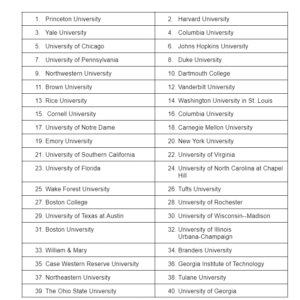
    Understanding Test Optional and Test Blind for Admission Cycles

    Here is a list of some Top Liberal Arts Colleges that are test-optional for the 2023-2024 admissions cycle:

    Some Liberal Arts Colleges and Universities Mandate SAT/ACT Testing

    There are some top universities and liberal arts colleges that require you to submit your SAT/ACT scores. Some of the schools that still require testing include Massachusetts Institute of Technology, Georgetown University (DC),  Georgia Institute of Technology, University of Florida, University of Tennessee, Knoxville, New College of Florida, Fisk University (TN), and New College of Florida.
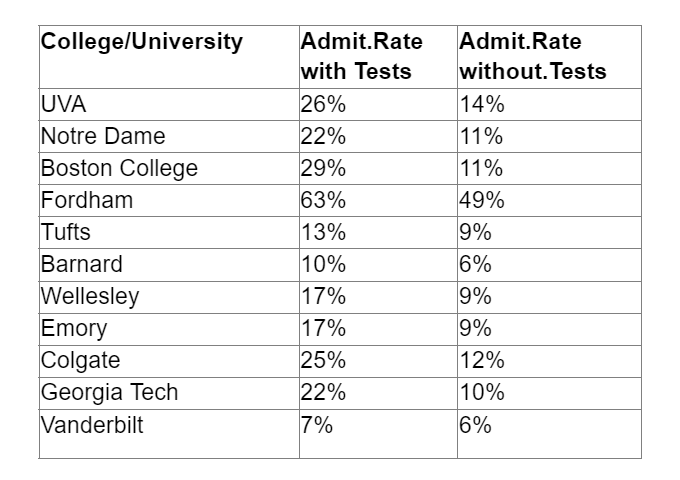
    With insights provided by education writer Jeff Selingo and information from various colleges and universities, we have created the following table to give you an overview about submitting test scores.

    On the face of the above information, it would appear that including a test score greatly increases your chances of acceptance. However, Common App data reported a 20% surge in applications which suggests that they are receiving applications from students that might have been put off applying when a test score was a requirement.
    Read More: Public versus Private Universities

    Were you aware that some universities have adopted a “test-blind” approach?

    Test-blind means that a college or university will not consider your SAT/ACT score as part of their evaluation process, even if you submit it. The University of California, for example, would only use your scores for course placements after you enroll.

    Here is a list from FairTest of some universities and colleges that are test-blind:

    • California Institute of Technology

    • California State University system (permanently at all 23 campuses)

    • Cornell University (through fall 2024 at the schools of Agriculture, Architecture, and Business)

    • City University of New York system (11 campuses, extended through Spring 2023 admissions)

    • University of California system (9 campuses)

    • Washington State University (4 campuses)

    • University of San Diego

    Is your high school profile competent enough or do you need to submit your score to the test-optional universities? If you need further guidance contact the Ivy Central team.

  • What are AP Tests and should I take them?

    What are AP Tests and should I take them?

    What are AP Tests and Why Should I Take AP Exams? Ivy Central


    Should I take AP Tests

    At Ivy Central, students often ask us: Are AP Tests necessary? How many should I take? Do colleges care which ones I choose? This blog addresses those questions and helps you decide whether Advanced Placement (AP) exams should be part of your college application strategy.

    What Are AP Tests?

    Advanced Placement (AP) Tests are standardized exams offered by the College Board, typically taken in May at the end of a year-long AP course. (The exams happen once a year in May.) These courses are designed to mirror introductory college-level classes and are available in many U.S. high schools and international schools. Students can also opt to self-study or take online AP courses through platforms like Pearson or Johns Hopkins CTY.

    Exam Format:

    • Most AP tests include multiple-choice and free-response sections.

    • Language exams include a speaking component.

    • Music Theory includes sight-singing.

    • Studio Art involves portfolio submissions.

    • Exams are scored from 1 to 5, with:

      • 5 = Extremely well qualified

      • 4 = Very well qualified

      • 3 = Qualified

      • 2 = Possibly qualified

      • 1 = No recommendation

    As of recent updates, the College Board now uses Evidence-Based Standard Setting (EBSS) to determine scoring thresholds, which has led to higher pass rates in some subjects.

    Digital AP Testing: What’s Changing in 2025?

    Starting May 2025, AP exams are moving toward digital testing using the College Board’s Bluebook app.

    • Fully Digital (No Paper Option): Humanities and Computer Science exams, including AP English Language, U.S. History, and Computer Science Principles.

    • Hybrid Format: Math and science exams like AP Biology, Calculus, and Physics will deliver questions digitally, but require hand-written responses for problem-solving sections.

    This shift to digital AP exams aims to enhance the overall testing experience in several key ways. First, it improves exam security by reducing the risk of lost papers and unauthorized access to exam content. Additionally, digital testing simplifies the administrative process for schools and test centers, streamlining setup, distribution, and scoring. Most importantly, it helps reduce opportunities for cheating by incorporating more secure and standardized digital environments, ensuring a fairer testing experience for all students. Score Setting and Scoring – AP Central | College Board

    What Subjects Can I Take?

    The College Board offers over 30 AP subjects across STEM, humanities, social sciences, and the arts. Popular and widely available choices include:

    • Sciences: Biology, Chemistry, Physics 1, 2, and C

    • Math: Calculus AB & BC, Statistics

    • Social Studies: U.S. History, World History, Psychology, Government

    • Languages & Arts: Spanish, French, Music Theory, Studio Art

    Updated Physics Curriculum: For the May 2025 AP exams, the AP Physics curriculum has been updated to align more closely with college-level coursework, emphasizing clearer expectations for essential content and skills. The revisions include:

    • AP Physics 1: A new Fluids unit has been introduced, expanding the course to eight total units.
    • AP Physics 2: The former Waves and Optics unit has been divided into two distinct units: Geometric Optics and Waves, Sound, and Physical Optics.
    • AP Physics C (Mechanics and Electricity & Magnetism): Both courses feature updated structures, with changes to the number and format of multiple-choice and free-response questions, along with a longer exam duration.

    How APs Help Your Application:

    1. Demonstrate Rigor: APs show that you can handle college-level material, especially if your school’s curriculum isn’t the most challenging.

    2. Showcase Academic Interests: Taking APs in subjects not offered at school signals intellectual curiosity and initiative.

    3. Compensate for Discontinued SAT Subject Tests: Since 2021, APs are one of the best ways to demonstrate subject mastery.

     Additional Benefits of Taking AP Exams

    1. Earn College Credit or Skip Intro Courses

    Scoring a 3 or above may allow you to skip general education courses in college, freeing time for advanced classes or electives—and in some cases, enabling early graduation.

    2. Strengthen Merit Scholarship Applications

    Some colleges factor AP performance into merit-based scholarship decisions. Taking APs can make you a more competitive candidate for financial aid.

    When Not to Take APs

    While APs are valuable, they are not for everyone. Consider skipping or delaying APs if:

    • Your school grades are struggling: Focus on improving GPA, which is often more critical.

    • Your extracurriculars are weak: Top colleges look for both academic strength and personal achievements.

    • You are already overwhelmed, and AP prep would compromise balance and well-being.

    Remember: Quality matters more than quantity. One well-prepared AP score is better than several poorly handled ones.

     Should You Take APs?

    Here’s a quick checklist to help you decide:

    • Are you academically strong and looking to challenge yourself?

    •  Do you want to demonstrate subject expertise not reflected in your school curriculum?

    • Are you aiming for top-tier colleges or merit scholarships?

    • Do you have the time to prepare without compromising your GPA or well-being?

    If you answered yes to most of these, AP exams may be a great addition to your college application strategy.

    Final Thoughts

    AP exams can significantly enhance your academic profile when used strategically. But they are just one part of a broader application narrative that includes GPA, extracurriculars, essays, recommendations, and standardized test scores (if required).

    If you’re unsure which APs to take or how they fit into your academic goals, reach out to Ivy Central. We’re here to help you build the right strategy for success.

    Here at Ivy Central, we get lots of questions about AP Tests, whether they are needed or useful in the US college application process, how many you should do, and are some subjects are more valuable than others. This article will help you answer these and other questions about AP Tests.

  • All Change for the SAT… But Not Yet.

    All Change for the SAT… But Not Yet.

    New SAT-Changes Announced

    The SAT, together with its near relation, the ACT, has been a feature of college applications for many years. As a result of the COVID pandemic most US colleges have moved to a ‘Test Optional’ application format, meaning that applicants can choose whether to submit an SAT or ACT score without it affecting their chances of acceptance. This test-optional format remains in place with most colleges for the 2022/23 round of applications and some colleges, including some of the most prestigious, have already announced that this will be the case for the following two application rounds.

    All of this has led to questions being asked about the future of standardised tests and if they are needed. The University of California colleges announced last year that they will no longer consider ACT or SAT good scores when making application decisions and an increasing number of colleges have followed a similar route.

    In an attempt to reinvigorate the SAT, the College Board, which owns the SAT, announced at the end of January that, following a trial in November 2021, they are going to make significant changes to the SAT and the way it is administered.

    What’s changing?

    • Going digital – the new SAT will be administered digitally meaning that those taking the test will be able to use their own computers, devices in schools or one issued by the College Board for the purpose of taking the test. The test will continue to be administered in school or a test centre, there will not be an option for students to take the test at home.

    • Format – when the new test is introduced it will take around two hours to complete, rather than the three hours required by the current test. The reading passages in the test will become shorter and the range of topics will become broader to better reflect what students read in college.

    •  Calculators – The maths section of the current test contains one section where calculators are allowed and a second where they are not. The new test will allow students to use calculators across the whole maths section of the test, indeed a graphing calculator will be built into the testing app.

    • Test security – the current pencil and paper test has come in for criticism when whole testing cycles in countries have been scrapped because the test has been leaked. The new digital test will enable each student to be set a test that is unique to them while retaining the same level of difficulty. This means that it will be virtually impossible for students to share answers or for questions to be leaked beforehand.

    • Results – sitting, waiting to find out what score you achieved in the SAT will still be there, but it should only be for days, rather than the current couple of weeks.

    • Flexibility – as a digital test there will no longer be a need for the SAT to a pre-set schedule. Currently there are six SAT administrations on dates that are set months in advance. The new test will enable schools and test centres greater choice of when, where and how often they administer the test.

    What’s not changing

    • Rigour – there is no suggestion in what the College Board has said that the test will become any easier. The SAT will still seek to assess the ability of the student to meet the challenges of study at college.

    • Scoring – The SAT will continue to be scored out of a total of 1600, 800 for the English section and a further 800 for the maths section.

    When does this happen?

    The new style SAT will be phased in over two years. Students taking the test in international centres will start using the new digital test from March 2023, while students in the US will take the new test for the first time in March 2024.

    Further information on the revamped SAT can be found on the College Board website.